
Howso: Rethinking Anomaly Detection for Real-World Data
Bridgette Befort DeFever
Real-world data is inherently complex, and anomalies amplify that complexity.
Anomalies are often unknown, unexpected, and diverse, with multiple types appearing within a single dataset. Traditional anomaly detection (AD) tools are typically tuned to identify just one kind of outlier, leaving them ill-equipped to handle the complexity of modern data environments and evolving agentic AI systems that depend on accurate, context-aware insight.
At Howso, we set out to change that.
A General-Purpose Approach That Outperforms
In new research benchmarks, Howso’s general-purpose anomaly detection algorithm outperformed every competing method, using an evolved version of the widely adopted AD-Bench framework.
AD-Bench has become a standard for evaluating anomaly detection performance. It traditionally injects one type of anomaly into each dataset, runs multiple algorithms against that dataset, and then reports each tool’s success rate per anomaly type. The final performance score reflects the average accuracy across all four types of anomalies tested independently:
- Global anomalies – points far from all others (traditional outliers)
- Local anomalies – points unusual within their local neighborhood
- Cluster anomalies – groups of points forming an unexpected cluster
- Dependency anomalies – records where the combination of features is unusual, even though each individual feature looks normal
While this approach provides a useful baseline, it doesn’t fully reflect real-world data conditions where multiple types of anomalies coexist in the same dataset. To address this, Howso’s research team extended AD-Bench to create a more realistic and comprehensive evaluation.
In the updated framework, Howso injected all four anomaly types in equal proportions into each dataset, then evaluated how well each algorithm could detect and distinguish them simultaneously. This evolution of AD-Bench better mirrors real-world challenges and moves the field toward a next-generation standard for evaluating anomaly detection algorithms.
And, despite this added complexity, Howso’s algorithm achieved top-tier performance across all anomaly types, demonstrating that a single, unified approach can handle the full spectrum of anomalies in real-world data. Even more notably, Howso’s algorithm not only detects anomalies, it classifies them, providing critical context to explain what went wrong, why it happened, and how to address it.
Why It Matters
Most anomaly detection tools are designed to solve one narrow problem. They may catch a global spike in sales but miss a subtle regional dip hidden inside an overall upward trend. In contrast, Howso’s approach is built to handle multiple anomaly types simultaneously, ensuring that no critical signal goes unnoticed.
By identifying not only that something is anomalous but what kind of anomaly it is, Howso provides richer insight for both analysts and autonomous agents. This empowers faster root-cause discovery, smarter responses, and more trustworthy automation.
The Results
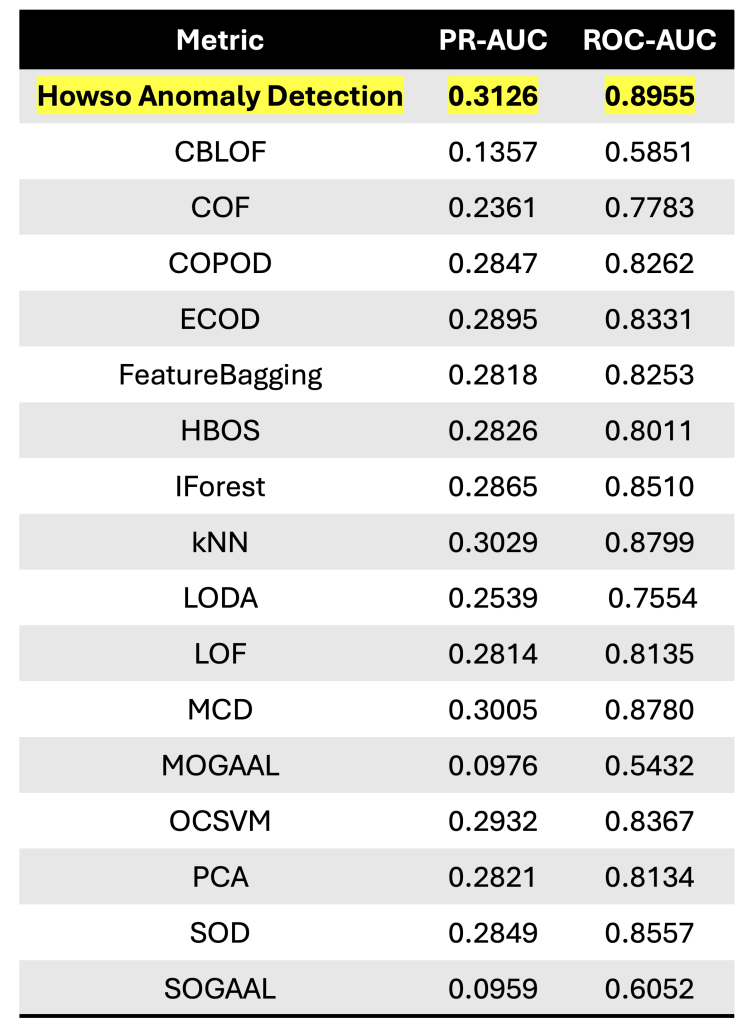
Across every dataset tested, Howso outperformed leading tools such as Isolation Forest, CBLOF, LOF, ECOD, and DeepSVDD in both accuracy and robustness. This consistent performance shows that a single, general-purpose algorithm can outperform specialized models across diverse anomaly types.
From Detection to Understanding
Built on the Howso Engine, our anomaly detection technology is fully explainable. Every decision can be traced directly to the underlying data that produced it. This transparency transforms anomaly detection from a black-box alert system into an interpretable, auditable process that drives informed action.
For agentic AI systems, that means being able to detect irregularities, understand their causes, and recommend the best next steps, all within one unified framework.
See the Difference
Howso continues to push the boundaries of trustworthy, interpretable AI. Explore our full benchmark results (+more!) [https://arxiv.org/abs/2510.22809], or contact us for a demo to see how Howso can help your organization detect, classify, and understand anomalies in real-world data.